




Why This Matters to Distributors: Wholesale trade reported stronger new orders and growing backlogs in August, but rising prices, slower supplier deliveries and higher inventories are complicating the outlook for distributors.
Wholesale trade demand strengthened in August as new orders and backlogs increased, even as distributors faced a more difficult mix of rising costs, slower supplier deliveries, and growing inventories.
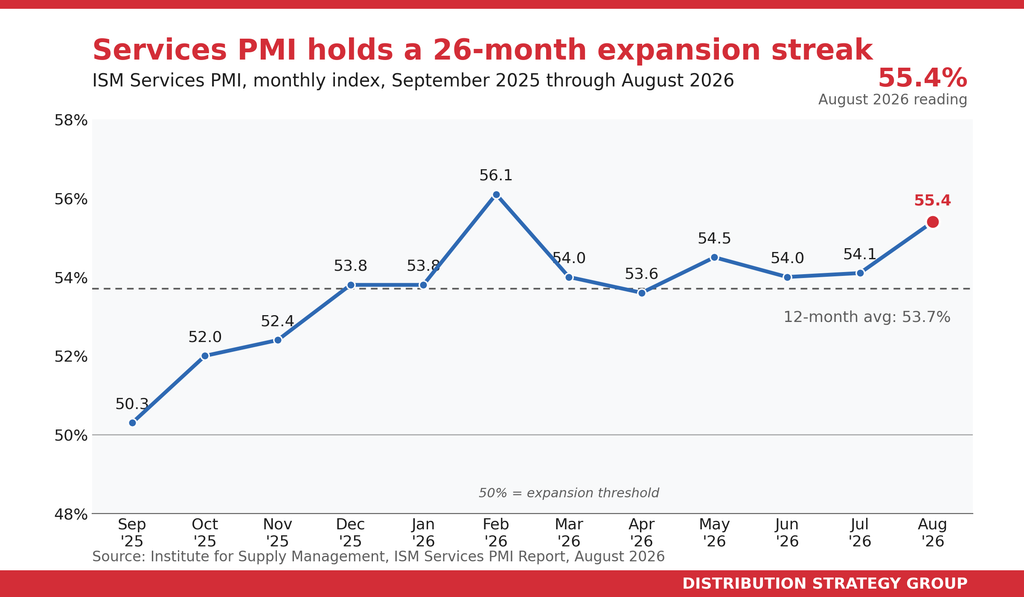
The gains came as the broader U.S. services economy accelerated. The Institute for Supply Management’s Services Purchasing Managers’ Index rose 1.3 percentage points to 55.4% in August from 54.1% in July, marking the 26th consecutive month of expansion. A reading above 50% indicates expansion.
New orders were a major driver. ISM’s New Orders Index climbed 3.7 percentage points to 60.9% from 57.2%, while the Business Activity Index rose 2.6 percentage points to 61.7% from 59.1%.
Wholesale trade was among the industries reporting growth in new orders, providing a direct indication that demand strengthened across the distribution sector during the month.
The improvement stands in contrast to manufacturing, where ISM reported this week that new order growth slowed in August. That divergence suggests demand moving through wholesale distribution remained stronger than conditions reported by some of the manufacturers supplying the sector.
Costs, however, are becoming a bigger concern.
ISM’s Prices Index increased 2.3 percentage points to 72.6% from 70.3% in July, its highest reading since August 2022. Prices paid by services organizations have increased for 111 consecutive months.
Wholesale trade was among 15 industries reporting higher prices in August, while no services industries reported lower prices.
Businesses reported rising prices for products and expenses with direct implications for distributors, including computers and related products, copper and copper products, diesel fuel, freight, gasoline, labor, memory products, petroleum-based products, software licenses, and steel products.
Supply constraints added to those pressures. Graphics processing units, labor, memory components, steel, steel products and wire and cable were among the items reported in short supply.
Supplier deliveries also remained slow. ISM’s Supplier Deliveries Index registered 51.3%, down from 52.8% in July. A reading above 50% indicates suppliers are taking longer to deliver products. Wholesale trade was among 10 industries reporting slower deliveries.
The combination of stronger demand and supply constraints contributed to a sharp increase in order backlogs. The Backlog of Orders Index rose 4.7 percentage points to 55.6% from 50.9%, with wholesale trade among the industries reporting higher backlogs.
Inventory is emerging as another potential pressure point.
The Inventories Index jumped 5.3 percentage points to 56.7% from 51.4%, marking the seventh consecutive month of inventory expansion. Wholesale trade was among the industries reporting increased inventories.
Businesses also became more concerned about how much stock they were carrying. ISM’s Inventory Sentiment Index increased to 54.1% from 52.5%. A reading above 50% indicates respondents consider inventories too high relative to current business requirements. Wholesale trade was among seven industries reporting inventories as too high.
Imports increased as well. The Imports Index rose 4.5 percentage points to 56.3% from 51.8%, with wholesale trade among seven industries reporting higher imports.
The labor picture was more mixed. ISM’s Employment Index remained in contraction territory at 47.8%, up slightly from 47.4% in July. Wholesale trade was an exception, reporting employment growth during the month.
For distributors, the August report points to an economy still generating orders but becoming more difficult to manage operationally. Demand is strengthening and backlogs are growing, but distributors are paying more for products and transportation while contending with supply shortages and slower deliveries.
The inventory numbers add another complication. Distributors are adding stock as orders rise, but some already consider inventories too high. That raises the stakes for purchasing decisions heading into the fall, particularly if demand begins to soften while product and transportation costs remain elevated.
Do not miss any content from Distribution Strategy Group. Join our list.
Share this article:
