



Why This Matters to Distributors: Manufacturers are forecasting stronger sales, production and capital spending over the next 12 months, a potentially positive demand signal for distributors serving industrial, machinery, electrical, automation and maintenance markets. But raw material, freight and fuel costs remain significant pressures on manufacturers and their supply chains.
U.S. manufacturers grew more optimistic about their business prospects in the third quarter, with expectations for sales, production, hiring and capital investment all improving from three months earlier, according to a new survey from the National Association of Manufacturers.
The NAM Manufacturers’ Outlook Survey found 78.9% of respondents were positive about their company’s outlook, up from 74.2% in the second quarter. The reading was the highest since the second quarter of 2022 and topped the survey’s historical average of 74.3%.
The survey, conducted Aug. 11-27, included responses from 220 manufacturers. Small manufacturers accounted for 18.6% of respondents, medium-sized manufacturers 45% and large manufacturers 32.3%. The remaining 4.1% did not disclose their size.
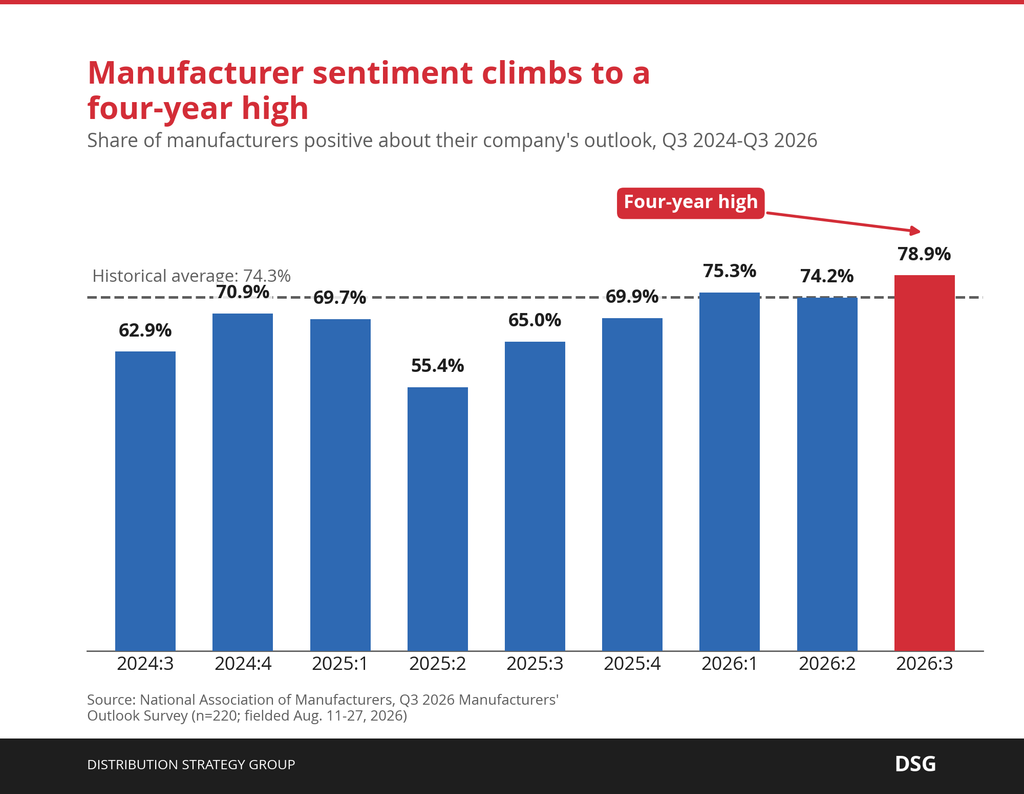
The more optimistic outlook was reflected across several measures of expected business activity.
Manufacturers expect sales to increase 4.3% over the next 12 months, up from a 3.3% forecast in the second quarter. Expected production growth increased to 3.8% from 3%, while projected full-time employment growth rose to 1.8% from 1%.
Sales expectations reached a four-year high. About 72% of manufacturers expect sales to increase during the next four quarters, including 50.5%, which anticipate growth of at least 5%. Just 8.3% expect sales to decline, while 20.2% expect no change. Medium-sized and large manufacturers forecast sales growth of 4.4%, compared with 3.5% among small manufacturers.
Production expectations also reached a four-year high. About 67% of respondents expect production to increase during the next year, while 8.7% anticipate a decline and 23.9% expect output to remain about the same.
Capital spending plans strengthened as well. Manufacturers expect capital investment to increase 2.6% during the next 12 months, up from 1.8% in the second quarter and the strongest forecast in four years. Half, 49.3%, expect to increase capital spending, compared with 37.1% in the previous quarter. Another 39.4% expect spending to remain unchanged, while 11.3% anticipate reductions.
The combination of higher sales, production and capital spending expectations could support demand for distributors supplying machinery, electrical equipment, automation products, fabricated metals and maintenance, repair, and operations products.
Cost pressures, however, remain widespread.
Increased raw material costs were cited by 80.8% of manufacturers as a current business challenge, making it the most frequently cited concern. Rising health care and insurance costs followed at 72.3%, with trade uncertainty at 62.4%, attracting and retaining workers at 54.9%, transportation and logistics costs at 52.1% and supply chain challenges at 44.6%. Respondents could select more than one challenge.
Manufacturers expect raw material prices and other input costs to increase an average 5% during the next 12 months, although that is down from the 5.8% increase forecast in the second quarter. 90% expect input costs to rise, and 48.1% anticipate increases of more than 5%.
At the same time, manufacturers expect prices for their own products to increase 3.7%, down from the 4.2% forecast in the second quarter. About 77% expect to raise prices during the next year, while only 1.9% anticipate price declines.
The survey also points to continued demand for industrial machinery despite uncertainty surrounding trade.
Among manufacturers that gave a definitive answer, 63% said they plan to import industrial machinery, including parts and components, during the next year to support existing or planned manufacturing operations. Among those planning imports, 69.2% said the equipment would be used to upgrade or replace existing machinery, while 63.6% cited new or expanded manufacturing operations. 32% expect to import parts or tools for maintenance and repair.
Trade uncertainty is already affecting some of those purchasing decisions. Among manufacturers that adjusted their industrial machinery import strategies, 41.3% said they sourced machinery from alternative suppliers or countries. Another 36.5% delayed planned orders, 19.1% decreased orders and 12.7% canceled planned orders.
Transportation costs are another continuing pressure on manufacturers.
99% of respondents said their companies or suppliers use trucks. Ocean or maritime transportation was used by 57.1%, air cargo by 37.7%, rail by 28.8% and intermodal transportation by 21.7%.
Among manufacturers reporting transportation problems, 77.3% cited freight rates as affecting their ability to move goods efficiently and 74.1% cited fuel costs. Driver availability was cited by 29.7%.
Manufacturers also indicated they plan to continue investing in their digital operations. About 31% said they will place significant emphasis on digital transformation during the next 12 months, and another 30.1% said they will place moderate emphasis on it. About 11% said they plan to put no emphasis on digital transformation.
The third quarter results point to manufacturers preparing for stronger business activity while continuing to manage substantial cost and supply chain pressures. For distributors, rising production, capital spending and machinery investment could provide opportunities for higher demand, but customers are likely to remain focused on pricing, sourcing flexibility, inventory management, and transportation costs.
Do not miss any content from Distribution Strategy Group. Join our list.
Share this article:
