



Why This Matters to Distributors: Manufacturers still expect sales and production to grow during the next year, supporting continued demand for industrial products. But a sharp increase in material costs, persistent logistics and supply chain problems, and tighter inventory management could put more pressure on distributors to manage pricing, maintain product availability and help customers secure critical equipment.
U.S. manufacturers expect sales and production to continue growing during the next 12 months, but sharply higher material costs and persistent supply chain pressures are creating a more challenging market for the distributors that supply them.
The National Association of Manufacturers’ second-quarter 2026 Manufacturers’ Outlook Survey found that 74.2% of manufacturers remained positive about their company’s outlook, down slightly from 75.3% in the first quarter and essentially even with the survey’s historical average of 74.3%. Manufacturers expect sales to increase 3.3% during the next 12 months, compared with a 3.8% increase projected three months earlier, while production is expected to rise 3%, down from the previous forecast of 3.5%.
For distributors, those forecasts point to continued underlying demand from manufacturing customers, but in a market where customers are likely to pay much closer attention to prices, sourcing and product availability. The bigger change is the rapid increase in costs confronting those customers.
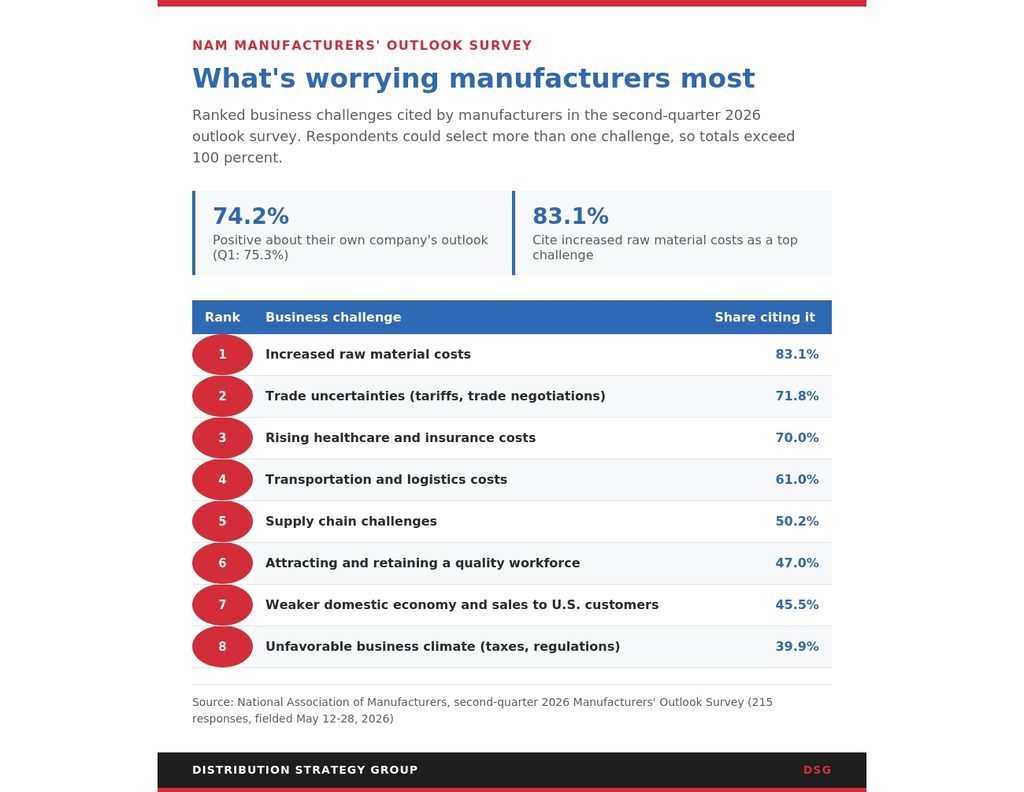
Raw material costs were cited as a business challenge by 83.1% of manufacturers, up sharply from 57.5% in the first quarter and making it the industry’s top concern. Trade uncertainty ranked second at 71.8%, followed by rising health care and insurance costs at about 70%.
Transportation and logistics costs were cited by 61% of manufacturers, while 50.2% identified supply chain challenges and 47% cited difficulty attracting and retaining workers. The survey, conducted May 12 through May 28, included responses from 215 manufacturers.
Manufacturers Expect Material Costs to Rise 5.8%
The biggest shift for distributors is occurring around costs, with manufacturers expecting raw material prices and other input costs to rise an average of 5.8% during the next 12 months. That is up sharply from the 4.1% increase projected in the first quarter.
More than 94% expect some increase in material costs, and nearly 60% anticipate increases exceeding 5%. Small and medium-sized manufacturers expect the largest increases, averaging 6.3%, compared with 5% among large manufacturers.
Manufacturers also expect to raise their own prices. Respondents forecast average product price increases of 4.2% during the next 12 months, up from 3.1% in the first quarter, with nearly 82% expecting to raise prices and just 2.4% expecting prices to decline.
NAM Chief Economist Victoria Bloom said manufacturers expect growth to slow across several measures while costs increase more rapidly. “Costs are anticipated to rise at a much faster pace than projected in the prior quarter,” Bloom said.
That creates a potentially difficult environment for distributors because manufacturers expect material costs to rise faster than the prices they charge customers. The gap could increase pressure throughout the supply chain to control purchasing, transportation and inventory expenses, while making distributor pricing discipline and communication with customers more important.
Machinery and Electrical Equipment Remain Critical
The survey also provides a direct signal about where manufacturers expect to need distributor support. More than half, 54.3%, identified industrial machinery, including electrical power distribution equipment or other industrial machinery, as among the products most critical to their operations during the next 12 months.
Other industrial machinery was specifically cited by 44.2% of respondents. About 22.1% identified legacy computer chips used in industrial equipment and vehicles, while 19.1% cited electrical power distribution equipment such as transformers, switchgear, circuit breakers and capacitors. Another 18.1% identified critical minerals, while 53.3% of manufacturers cited energy inputs as critical to operations.
For industrial, electrical and automation distributors, those results suggest manufacturers are still investing in equipment and components needed to keep plants operating even as they become more cautious about costs. The opportunity could be particularly important for distributors that can provide technical expertise and help customers locate equipment that is difficult to source.
Supply Chain Problems Remain a Distributor Issue
Supply chain pressures remain a significant concern, with half of manufacturers identifying supply chain challenges and 61% citing transportation and logistics costs. Those pressures are occurring even as manufacturers expect production to increase 3% during the next year.
Nearly 62% expect production to rise, while 14.9% expect a decline and 23.3% expect production to remain about the same. Sales expectations show a similar pattern, with nearly 64% expecting sales to increase during the next four quarters, including 39.1% forecasting increases of at least 5%. About 13.5% expect sales to decline.
That combination matters for distributors because manufacturers are not forecasting a broad contraction in demand. Instead, many expect to produce and sell more while simultaneously dealing with higher costs and continued supply chain uncertainty, increasing the value of distributors that can provide dependable availability, alternative sources, shorter lead times and local inventory.
Manufacturers Keep Inventories Tight
Manufacturers also appear reluctant to build substantial inventories as uncertainty persists. Respondents expect inventories to increase just 0.2% during the next 12 months, while 48.1% expect inventories to remain about the same.
About 27% plan to increase inventories, while roughly 25% expect to reduce them. That restraint could shift more of the inventory burden upstream to distributors as manufacturers try to keep less material on their own shelves without risking interruptions to production.
Manufacturers operating with leaner inventories will depend more heavily on suppliers that can keep critical products available and deliver them quickly. For distributors, that could increase the importance of inventory planning, demand forecasting, vendor relationships and branch-level product availability.
Middle East Conflict Adds Supply Pressure
Manufacturers also reported significant effects from the conflict in the Middle East, with 72% saying it had increased their energy costs. Another 43.1% reported higher costs for nonenergy inputs, including aluminum, petrochemicals, fertilizer and related materials, while 14.2% reported difficulty sourcing nonenergy inputs.
NAM said the disruption is contributing to the sharp increase in manufacturers’ raw material concerns. For distributors, the effects could extend beyond higher supplier prices because disruptions involving energy, petrochemicals, metals and other materials can move through industrial supply chains and affect transportation costs, product availability and lead times.
Capital Spending Continues
Manufacturers are not broadly pulling back on investment, with respondents expecting capital spending to increase 1.8% during the next 12 months. That is slightly above the 1.7% increase projected in the first quarter.
About 37% expect to increase capital spending, while 49.3% anticipate no change and 13.6% expect reductions. The continued investment, combined with the importance manufacturers place on machinery and electrical equipment, provides another positive demand signal for distributors serving manufacturing plants.
Manufacturers are becoming more selective, however. Expectations for sales, production and hiring have moderated from the first quarter, suggesting customers are likely to scrutinize new spending more carefully and put greater emphasis on the productivity or operational benefits of their investments.
Digital Transformation Moves Deeper Into Plants
Technology also remains a priority, with about 35% of manufacturers saying they will place significant emphasis on digital transformation during the next 12 months and another 30.5% planning a moderate emphasis. Only 9.4% expect to put no emphasis on digital transformation.
Artificial intelligence is beginning to move closer to frontline manufacturing operations. Among manufacturers that definitively reported providing AI training, 78.5% offer introductory or awareness training, 42.1% provide training on using AI for production, quality, maintenance or logistics, and 36.4% train employees to operate AI-enabled machinery, equipment or software.
That trend could create another opportunity for distributors whose role extends beyond supplying products. As manufacturers connect automation, industrial equipment and software more closely, distributors with technical specialists and automation expertise could become more important in helping customers select, install and support increasingly sophisticated equipment.
A More Demanding Manufacturing Customer
The overall message for distributors is not that manufacturing demand is contracting, but that the customer environment is becoming more demanding. Manufacturers expect sales to rise 3.3%, production to increase 3% and capital investment to grow 1.8% during the next year, while nearly three-quarters remain positive about their company’s outlook.
At the same time, manufacturers expect material costs to rise 5.8%. More than eight in 10 identify material costs as a challenge, 61% cite transportation and logistics costs and half continue to report supply chain problems.
That combination is changing what manufacturers need from distributors. Price will remain important, but so will product availability, sourcing alternatives, inventory management, logistics and technical expertise.
Manufacturers that keep their own inventories lean while maintaining or increasing production will have less room for supply disruptions. For distributors, the NAM survey points to a manufacturing market that is still growing, but one in which keeping customers supplied reliably and helping them manage rising costs could become an increasingly important competitive advantage.
Do not miss any content from Distribution Strategy Group. Join our list.
Share this article:
