




Why This Matters to Distributors: U.S. wholesale sales rebounded in July and remained sharply above year-ago levels, while inventories continued to rise. Sales increased more than twice as fast as inventories from a year earlier, pushing the inventory-to-sales ratio down to 1.20 from 1.28. For distributors, the numbers point to stronger inventory productivity but also increase the importance of balancing lean inventories against product availability.
U.S. wholesale sales rebounded in July and climbed 13% from a year earlier, while inventory growth continued to trail the increase in sales, according to new data from the U.S. Census Bureau.
Sales by merchant wholesalers totaled a seasonally adjusted $801.3 billion in July, up 0.8% from June and 13% from July 2025, according to the Monthly Wholesale Trade Report released Sept. 10.
The July increase followed a 2.9% decline in June. Census revised the June decrease slightly from its preliminary estimate of 3%.
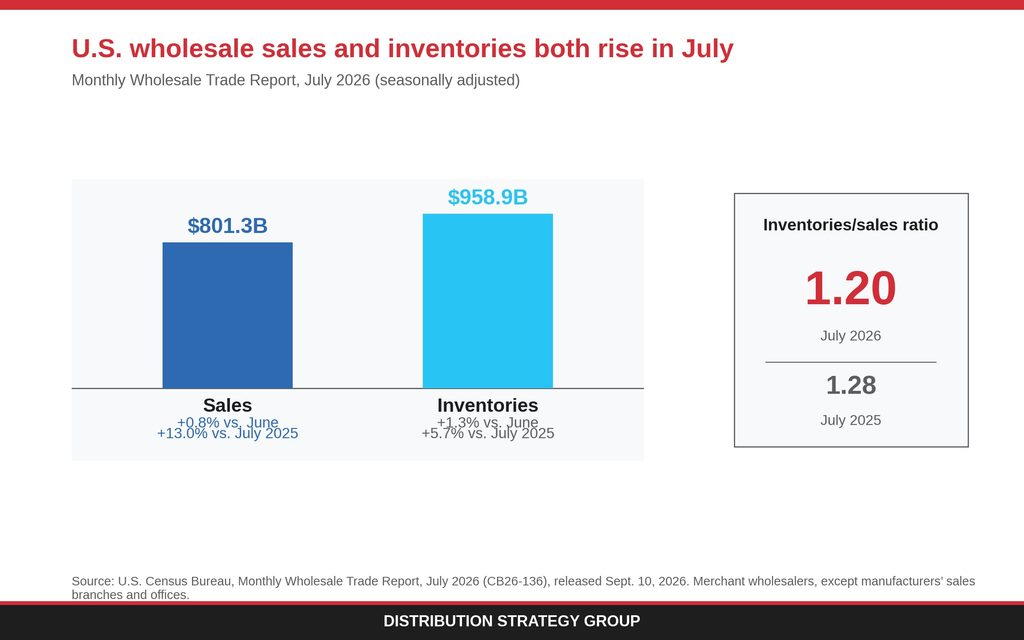
Inventories also increased in July, but the year-over-year gain remained well below the increase in sales.
Merchant wholesalers held $958.9 billion in inventories at the end of July, up 1.3% from June and 5.7% from July 2025. The monthly increase was unchanged from the Census Bureau’s advance estimate.
The widening gap between sales and inventory growth is an important operating signal for distributors.
Sales increased 13% from a year earlier while inventories rose 5.7%, a 7.3 percentage point difference. That indicates sales dollars are moving faster than the dollar value of inventory is increasing.
The trend is also showing up in the inventory-to-sales ratio.
The ratio fell to 1.20 in July from 1.28 in July 2025. The measure compares the value of inventory wholesalers hold with their current sales.
Distributors Get More Sales from Inventory
The lower ratio suggests wholesalers overall are generating more sales relative to the inventory they carry than they were a year ago.
That matters because inventory is a major use of working capital for distributors. Faster inventory movement can free up cash, reduce carrying costs and lessen the risk that products become obsolete or require discounting.
But the July numbers do not necessarily make a case for cutting inventory further.
If sales remain elevated, distributors will have to balance inventory efficiency with service levels and product availability. Companies that become too aggressive in reducing stock could face shortages or longer fulfillment times if replenishment fails to keep pace with sales.
The July results therefore put greater emphasis on inventory productivity rather than simply inventory reduction. Distributors need to determine whether the products they are carrying are supporting sales and customer service or tying up capital in slower-moving stock.
The national numbers suggest the wholesale sector has so far kept inventory growth from overtaking sales growth.
13% Sales Gain Comes with an Important Caveat
The size of the year-over-year sales increase also requires context.
Census adjusts the wholesale figures for seasonal variations and differences in trading days, but the numbers are not adjusted for price changes.
The 13% increase therefore represents growth in the dollar value of wholesale sales. It does not mean distributors sold 13% more products or that unit demand increased by 13%.
Price increases can raise reported sales even if the physical volume of products sold grows more slowly.
The same qualification applies to inventories. The 5.7% increase measures the dollar value of products held by wholesalers, not the change in the physical quantity of goods in warehouses and distribution centers.
For distributors, that makes the relationship between sales, inventories and the inventory-to-sales ratio particularly important. Regardless of how much of the increase reflects prices, sales values have risen faster than inventory values over the past year.
Inventory Discipline Moves into Focus
The next several months will show whether distributors can maintain that balance.
If sales continue to increase while inventory growth remains comparatively restrained, distributors could continue to improve the amount of revenue generated from the inventory they carry.
If inventories accelerate while sales growth slows, however, distributors could face a different problem: more working capital tied up in stock and greater exposure to excess or slow-moving inventory.
The opposite risk also bears watching. If sales remain strong while inventories become increasingly lean, distributors could face pressure on fill rates and product availability.
For now, the July report shows wholesale distribution entering the second half of 2026 with sales dollars above year-ago levels and inventory growth running at less than half the pace of sales growth.
The Census Bureau’s Monthly Wholesale Trade Survey covers merchant wholesalers, including distributors, jobbers, drop shippers and import-export merchants. It excludes manufacturers’ sales branches and offices.
Do not miss any content from Distribution Strategy Group. Join our list.
Share this article:
